AI agents aren’t just reasoning models with memory — they’re infrastructure workloads
For months, I obsessed over prompts, tools, and reasoning loops. Then I hit production — and the reality set in.
Here’s what finally became clear to me: Once an agent leaves the demo phase, it stops being a reasoning problem. It becomes a systems engineering problem.
Three infrastructure realities determine whether agents actually scale:
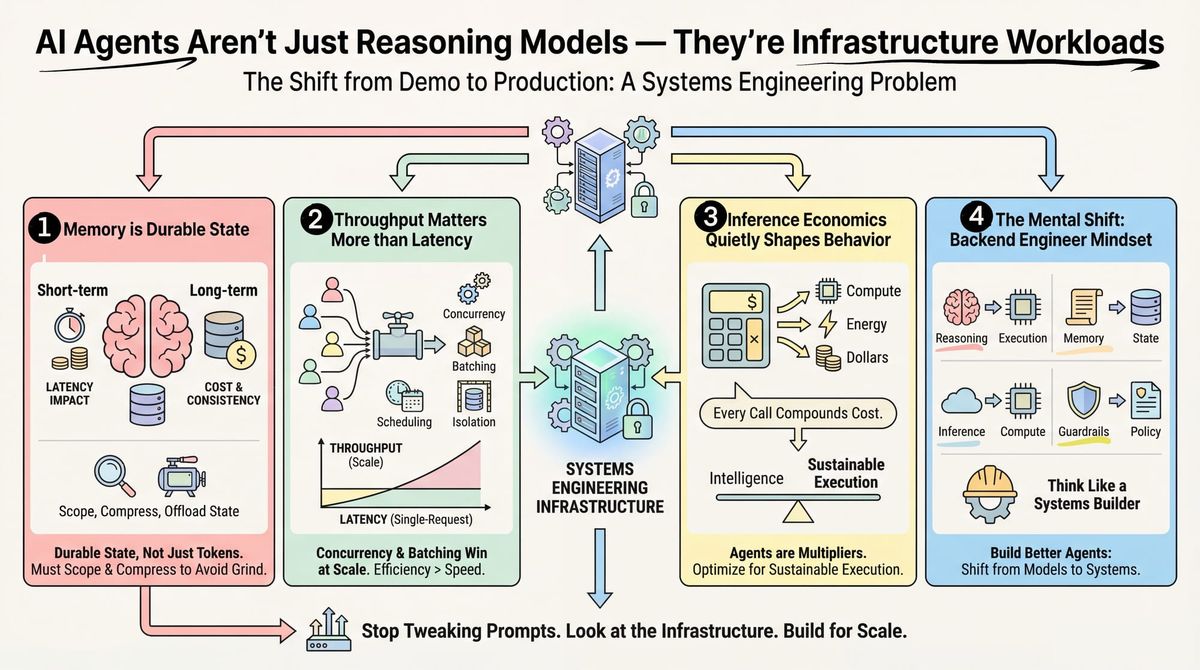
1️⃣ Memory is durable state. – We often treat context like “just more tokens.” That works — until production. In real systems, memory becomes your biggest cost and performance lever:
- Short-term memory directly impacts latency
- Long-term memory drives retrieval cost and consistency
If you don’t scope, compress, and offload state, agents don’t just slow down — they grind to a halt.
2️⃣ Throughput matters more than latency – One fast agent is easy. But running hundreds of concurrent agents — chaining inference calls, sharing resources, and retrying on failure — is a different beast.
Performance stops being about single-request speed and starts being about:
- Concurrency and batching
- Scheduling and isolation
- Raw execution efficiency
At scale, throughput wins every time.
3️⃣ Inference economics quietly shapes behavior – Agents are inference multipliers. Every fallback, tool call, and internal “thought” compounds real cost — in compute, energy, and dollars.
The best systems don’t just maximize intelligence; they optimize for sustainable execution.
💡 The mental shift To build better agents, start thinking like a backend engineer:
- Memory → State
- Reasoning → Execution
- Inference → Compute
- Guardrails → Policy
If your agents feel “off” as you scale, stop tweaking prompts. Look at the infrastructure underneath them.