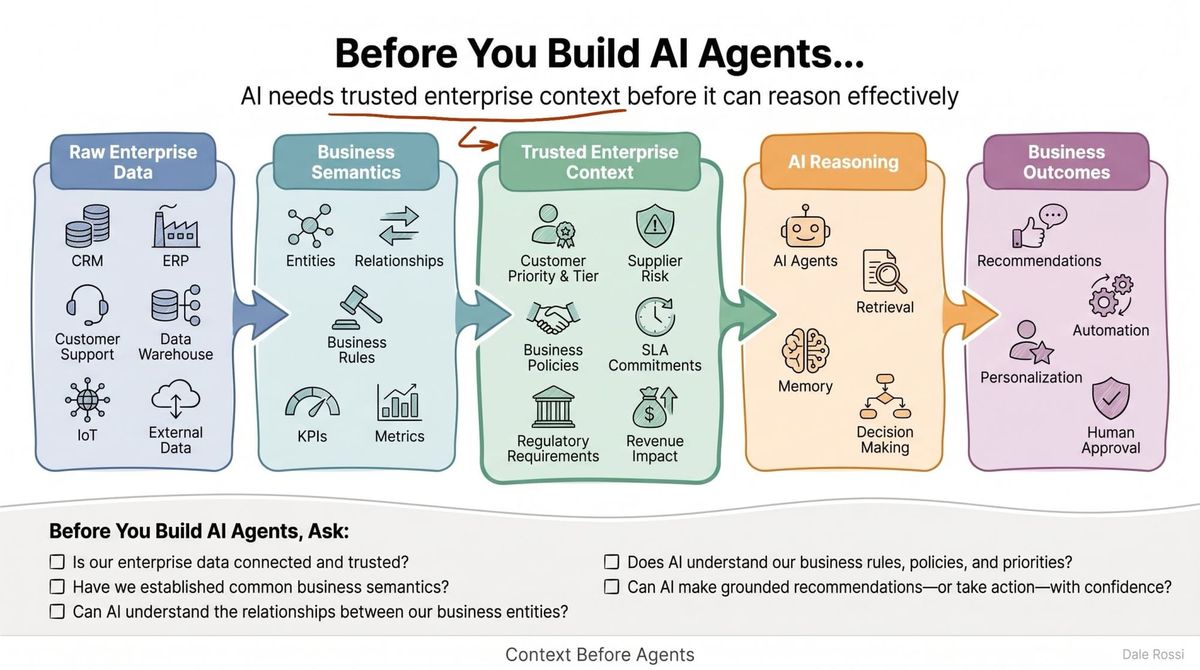
𝗕𝗲𝗳𝗼𝗿𝗲 𝗬𝗼𝘂 𝗕𝘂𝗶𝗹𝗱 𝗔𝗜 𝗔𝗴𝗲𝗻𝘁𝘀...
Everyone is asking:
• Which agent(s) should we build?
• Which framework and tools should we use?
• Which model(s) should we choose?
After spending the past several months building and studying enterprise AI architectures, I’ve come to believe those are the wrong first questions.
The biggest challenge isn’t building agents.
It isn’t choosing another framework.
The biggest challenge is giving AI enough business understanding to reason effectively.
Most enterprises already have enormous amounts of data.
The problem is that the data is fragmented, inconsistent, and often lacks business meaning.
An AI agent doesn’t just need customer records.
It needs to understand:
• How those records relate
• What the business rules are
• Which metrics matter
• Which policies apply
• When action should be taken
Technologies such as enterprise search, vector search, GraphRAG, and knowledge graphs are essential building blocks. They help AI retrieve relevant information and connect relationships.
But enterprise AI requires something more.
It also requires trusted enterprise context—a shared understanding of the relationships, business rules, metrics, policies, and operational knowledge that define how the business actually operates.
Examples include:
• Customer priority and tiers
• Supplier risk and dependencies
• Business policies and approval rules
• Service-level agreements (SLAs)
• Regulatory requirements
• Inventory thresholds
• Revenue impact and business priorities
This is a mental model I’ve found most useful when thinking about enterprise AI:
𝗥𝗮𝘄 𝗗𝗮𝘁𝗮 → 𝗕𝘂𝘀𝗶𝗻𝗲𝘀𝘀 𝗦𝗲𝗺𝗮𝗻𝘁𝗶𝗰𝘀 → 𝗧𝗿𝘂𝘀𝘁𝗲𝗱 𝗘𝗻𝘁𝗲𝗿𝗽𝗿𝗶𝘀𝗲 𝗖𝗼𝗻𝘁𝗲𝘅𝘁 → 𝗔𝗜 𝗥𝗲𝗮𝘀𝗼𝗻𝗶𝗻𝗴 → 𝗕𝘂𝘀𝗶𝗻𝗲𝘀𝘀 𝗔𝗰𝘁𝗶𝗼𝗻
The organizations that succeed won’t necessarily be the ones that build the most agents – they’ll be the ones that first make their business understandable to AI.