The AI Integration Tax: Is Your Architecture Bleeding Money?
Your AI strategy might have a hidden million-dollar leak.
I previously described the Model Context Protocol (MCP) as the "Nervous System" for the enterprise. Today, let’s look at P&L impact.
Many technical leaders are walking into a mathematical trap known as the "M × N Problem." It is the single biggest reason AI initiatives fail to scale profitably.
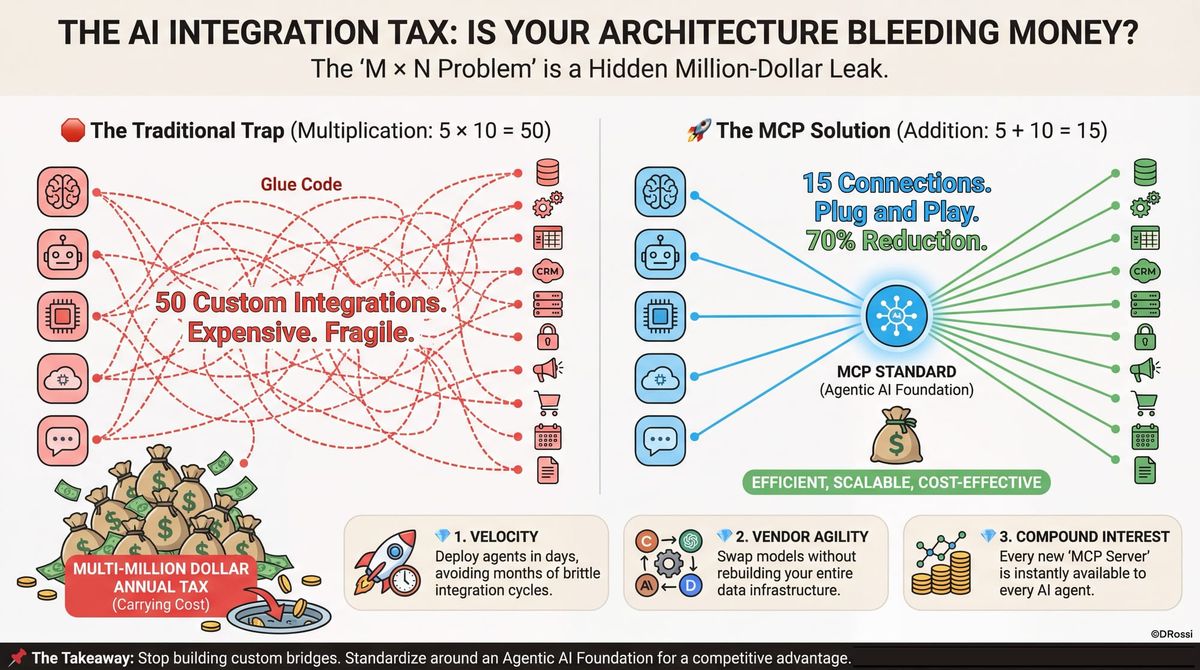
🛑 The Traditional Trap (Multiplication) If you want to connect 5 AI models to 10 enterprise tools, you typically build a custom bridge for every combination. That is 50 custom integrations (5 models × 10 tools).
Data from Merge.dev suggests the annual "carrying cost" of just one productized integration ranges from $50,000 to $150,000. When you do the math on a 50-connection web, you are looking at a multi-million dollar annual tax just to keep the lights on.
You are paying for "glue code," not innovation.
🚀 The MCP Solution (Addition) By adopting the MCP standard, we shift the math from multiplication to addition.
Instead of 50 bridges, you build 15 connections (5 models + 10 tools). Any model can "plug and play" with any tool instantly. You effectively slash your integration surface area by 70%.
Here is why this will be part of the Boardroom Conversation for 2026:
💎 1. Velocity Deploy agents in days, avoiding months of brittle integration cycles.
💎 2. Vendor Agility Swap models (Claude to GPT to Gemini) without rebuilding your entire data infrastructure.
💎 3. Compound Interest Every new 'MCP Server' added to your architecture becomes a permanent asset, instantly accessible to every future agent without a single line of new glue code.
📌 The Takeaway: Stop building custom bridges if you haven’t already. They are expensive, fragile, and create massive technical debt. Standardizing around an Agentic AI Foundation turns your architecture into a competitive advantage.
Still paying the "M × N Tax," or have you moved to a standardized protocol?